The debate on the appropriate fees for a financial adviser never seems to end.
We recently had an interesting discussion with a client who felt that advisory fees are a drag on portfolio returns and can significantly erode wealth over the long term. His view was that advisory fees should either be a flat amount or substantially lower.
It is a valid concern, and as a fee-only investment adviser, we acknowledge that we have an inherent conflict while writing on this subject. However, our objective is not to justify our fees but to provide a broader perspective on what investors should actually evaluate.
For this analysis, we compared seven different approaches. We assumed an investment of ₹1 crore made 10 years ago, with portfolio values calculated using returns available up to 30 June 2026.
The seven approaches were:
- Do not do anything and park the entire investments in 10-year Fixed Deposits.
We have considered 10year deposit rates of SBI as on 30-06-2016 which was 7% p.a. pretax. We have ignored taxation for simplicity reasons. No fees and brokerage paid to distributor/adviser.
- DIY investor following a passive index strategy.
We have considered the annualized returns of the UTI Nifty 50 Index Fund (Direct Plan) for the period from 30-06-2016 to 30-06-2026. The returns are based on the Direct Plan, and the underlying return and expense ratio data has been sourced from Value Research (valueresearchonline).
- DIY investor following an actively managed flexi-cap strategy.
We have considered the average annualized returns of the Equity Flexi Cap category for the period from 30-06-2016 to 30-06-2026. The returns are based on Direct Plans, and the underlying return and expense ratio data has been sourced from Value Research (valueresearchonline).
- Investing through a Mutual Fund Distributor using an passive index strategy.
We have considered the annualized returns of the UTI Nifty 50 Index Fund (Regular Plan) for the period from 30-06-2016 to 30-06-2026. The returns are based on the Regular Plan, and the underlying return and expense ratio data has been sourced from Value Research (valueresearchonline).
- Investing through a Mutual Fund Distributor using a flexi-cap strategy.
We have considered the average annualized returns of the Equity Flexi Cap category for the period from 30-06-2016 to 30-06-2026. The returns are based on Regular Plans, and the underlying return and expense ratio data has been sourced from Value Research (valueresearchonline).
- Investing through a Fee-only adviser using a passive index strategy.
We have considered the annualized returns of the UTI Nifty 50 Index Fund (Direct Plan) for the period from 30-06-2016 to 30-06-2026. The returns shown are net of the advisers 0.25% annual advisory fee. The underlying fund return data has been sourced from Value Research (valueresearchonline).
- Investing through a fee-only adviser using an actively managed strategy.
We have considered the equal-weighted annualized returns of the following funds for the period from 30-06-2016 to 30-06-2026: Parag Parikh Flexi Cap Fund (Direct Plan), HDFC Flexi Cap Fund (Direct Plan), DSP Flexi Cap Fund (Direct Plan), Franklin India Flexi Cap Fund (Direct Plan), Bandhan Flexi Cap Fund (Direct Plan) and ICICI Prudential Value Fund (Direct Plan). These were the largest diversified equity mutual funds at that time. The returns shown are net of our 0.50% annual advisory fee. The underlying fund return data has been sourced from Value Research (valueresearchonline).
All figures in INR
 Our observations
- The fee-only advisory model with an actively managed approach delivered the best overall outcome in our study, despite charging advisory fees.
- Investors should focus less on the fee charged and more on the value created. The relevant question is not, "How much did I pay?" but rather, "How much additional wealth did I create after paying all costs?"
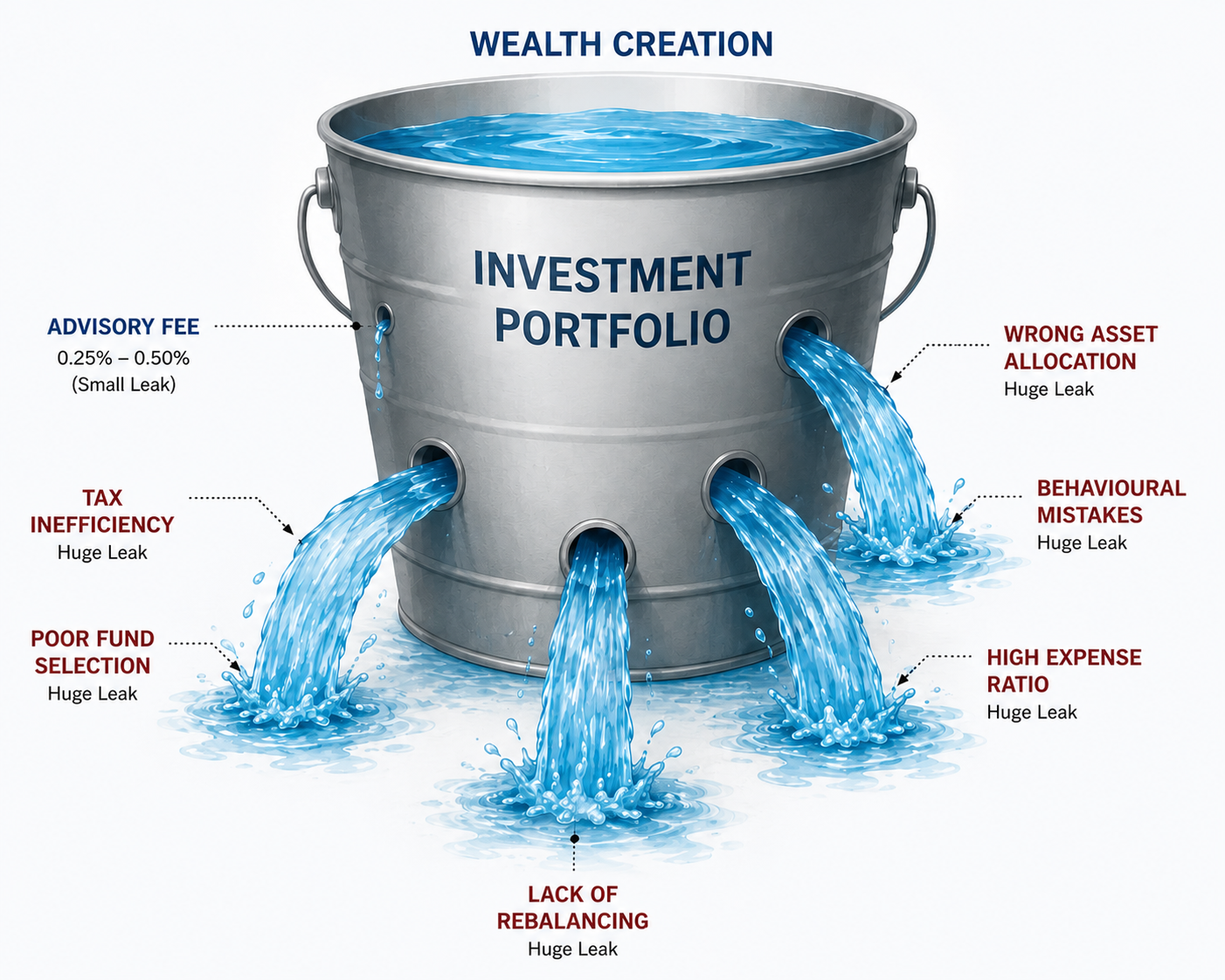
- Poor investment decisions can be far more expensive than reasonable advisory fees. Lower-cost investing or self-management is beneficial only if it delivers comparable long-term outcomes. If it results in lower returns, inadequate diversification, behavioural mistakes, or tax inefficiencies, the hidden cost may be significantly higher than the advisory fee itself.
At Naveen Rego Capital, a SEBI Registered Investment Adviser (RIA) and fee-only wealth management firm, we generally charge 0.50% per annum (plus applicable GST) on actively managed investment portfolios.
For clients seeking comprehensive financial planning—including insurance reviews, asset allocation, retirement planning, NPS management, tax-efficient investing, and overall financial guidance—we also offer fixed-fee planning engagements, at additional fees starting at ₹15,000 per annum, depending on the scope of services.
One practice we encourage is for clients to pay advisory fees directly from their investment portfolio rather than from their regular cash flows. This allows the portfolio to remain self-sustaining while making the cost of advice transparent and easy to monitor.
Ultimately, the cheapest advice is not always the most economical, and the most expensive advice is not always the best. What truly matters is the net outcome after all costs, taxes, and behavioural decisions have been accounted for.
Do you still feel advisory fees are a drag on portfolio returns?? We would love to hear your thoughts.
If you have missed any of our previous articles, please visit https://naveenrego.com/blog-grid.php?aW5pdGlhdGl2ZXNfdHlwZV9pZA=MQ
Happy Financial Planning!
Naveen Julian Rego – CFP®
MD & Principal Officer
Naveen Rego Capital
SEBI Registered Investment Adviser
Reg No: INA000019211
BSE Membership ID: 2178
Disclaimers:
- Investment in the securities market is subject to market risks. Read all related documents before investing.
- Registration granted by SEBI, enlistment as IA with Exchange, and certification from National Institute of Securities Market (NISM) in no way guarantee the performance of the intermediary or provide any assurance of returns to investors.
- Financial products recommended by us that are under the jurisdiction of other regulators are beyond the scope of SEBI’s grievance redressal mechanism.
- The above study is purely educational and not an investment advice. Past performance of any financial security is not an indication of future returns.